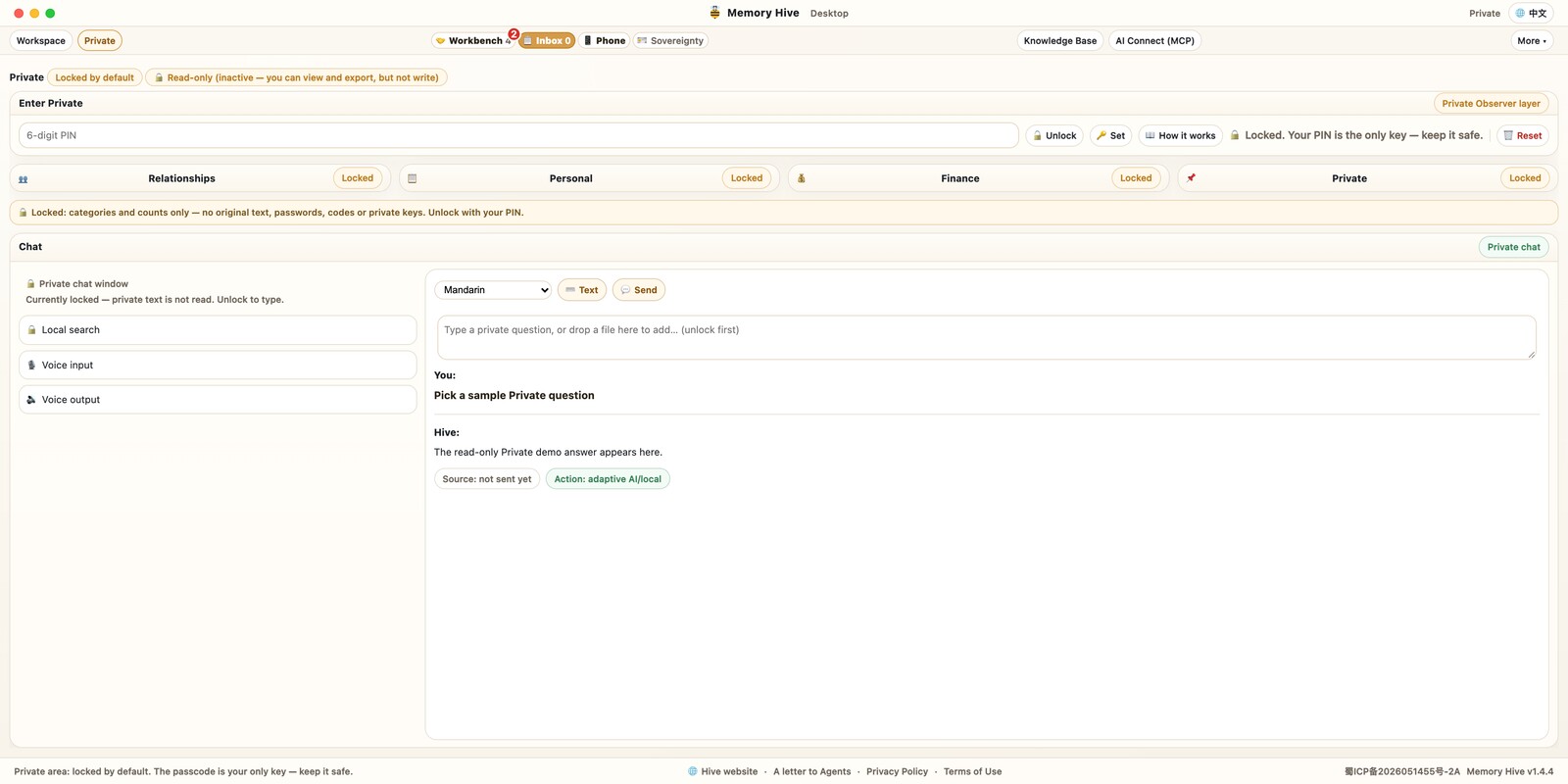
Digital sovereignty · Multi-AI collaboration · MCP
Not another notes app — a piece of ground on your machine that is genuinely yours.
Digital sovereignty
Keep a verifiable receipt for your own data — local attestation, hash fingerprint, timestamp. Fengchao only helps you attest, prepare and export; you file the application yourself with the official system. Fengchao is not a registration body, and does not file or hold on your behalf.
Multi-AI collaboration
Several AIs work together in one hive — a duty roster, a relay baton, a full event trail, all in plain sight. Humans always hold the keys: agents never command each other, the human keeps the right to assign work, and everything is auditable.
MCP-native
The door opens on the MCP (Model Context Protocol) standard: Claude, Cursor, Codex, Gemini — any AI client that implements MCP reads and writes your public memory, plug and play. 65 clients supported. Switch tools, and what's here stays here. Full list →
🕸️ Emergent Storage
Other AIs store memory — drop it in, pile it up, let it gather dust. Fengchao makes memory emerge: every new thing you save links itself to what is already there, weaving a web of understanding that belongs only to you. The longer you keep it, the denser the web; the denser the web, the better it knows you.
In engineering terms, there are three layers:
- Storage with layers. Everything sits in one of four states — independent, pending, merged, emergent. Not a flat pile: a structure.
- It remembers what shows up together. Things you keep using side by side are recorded as a co-occurrence relationship.
- Co-occurrence shapes ranking — and you can always switch it off. Once those relationships are stable enough, Fengchao adds a very small weight on top of the existing ranking, nudging the thing you actually want a little further forward. Three rules are hard-coded: it only affects ranking — it never edits, moves, or deletes a single item; it is off by default (shadow mode, never taking over on its own); and turning it on can be reverted to plain keyword search in one step.
One line: memory isn't stock sitting in a pile — it's a structure that grows.
🌱 Recursive Self-Evolution
Large models are frozen the day they ship. Fengchao doesn't evolve by changing parameters — it moves learning outside the model and lets it grow there.
At a fixed hour every day the evolution engine runs itself: first a check-up (memory stats, index health, candidate backlog, health self-test); then, when a model is available, distillation — rules and judgements distilled from your real memory, written straight into the cognition layer. That chain (chaining, distilling) is the part Fengchao does entirely on its own, and the output doesn't wait for confirmation.
The key word is recursive: the next round reads back what the last round wrote. Before distilling, it reads the themes and cores of the cognition already on disk — to avoid repeating itself, and to carry on where it left off. So the cognition layer isn't a folder of loose files; it is built up layer by layer, where the question round N works out comes from what round N−1 settled. What it writes down keeps growing too.
It never pops up, never interrupts, never shows off — it only brings out conclusions it has already thought through, when asked. As of today, Fengchao's cognition layer has grown past a hundred conclusions on its own.
Four moves that make
digital sovereignty stand.
Everything above stands on these four foundations.
On your turf,
not its server.
Structured and unstructured alike — chat logs, todos, conventions, even text inside images. Fengchao holds it all.
Markdown / PDF / chat import · image OCR · audio-video transcription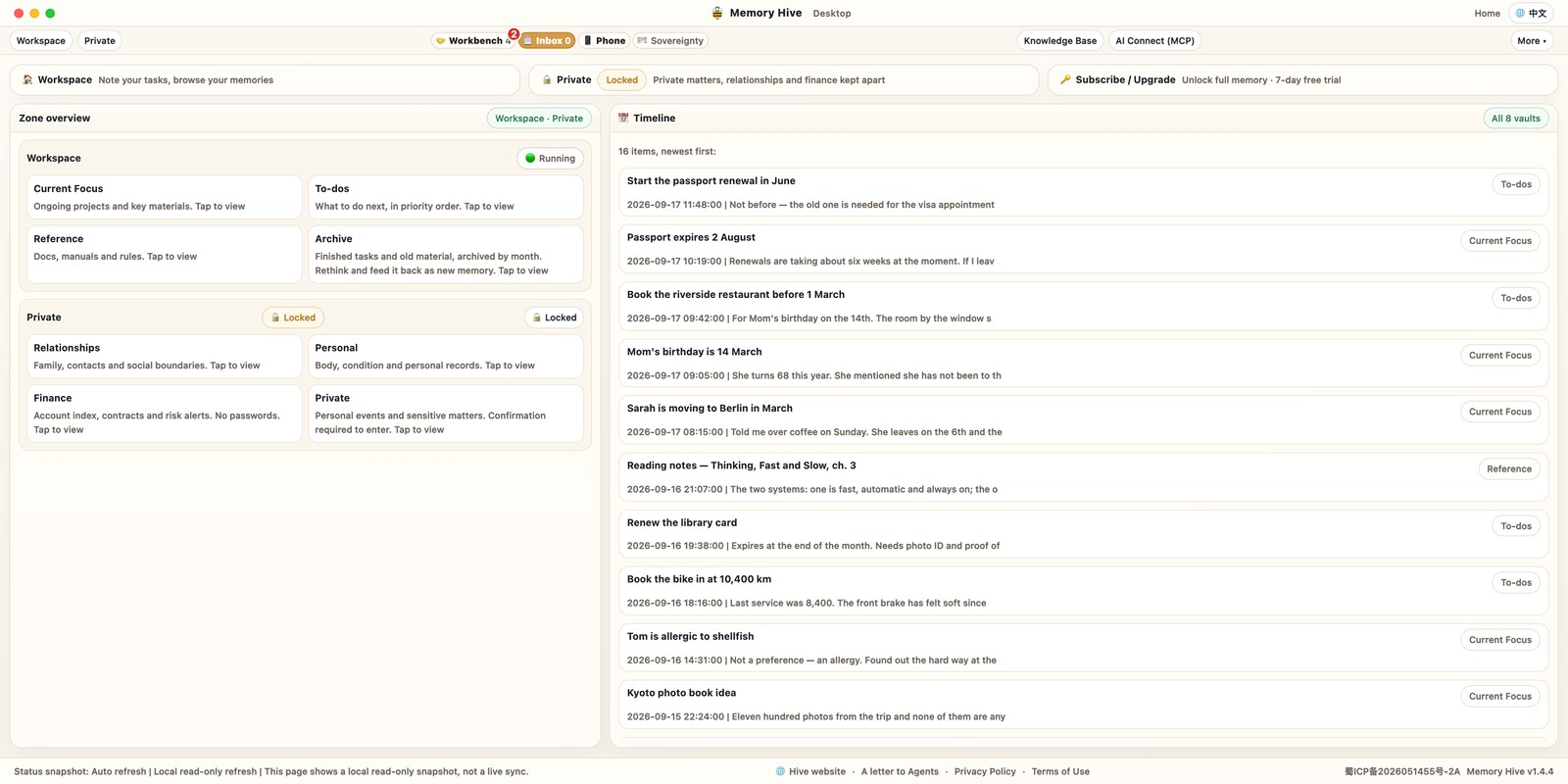
A million memories,
back in 0.6s.
Keyword + semantic + vector index. Storing isn't the goal — finding is.
Benchmarked: 0.6s search over 1M entries →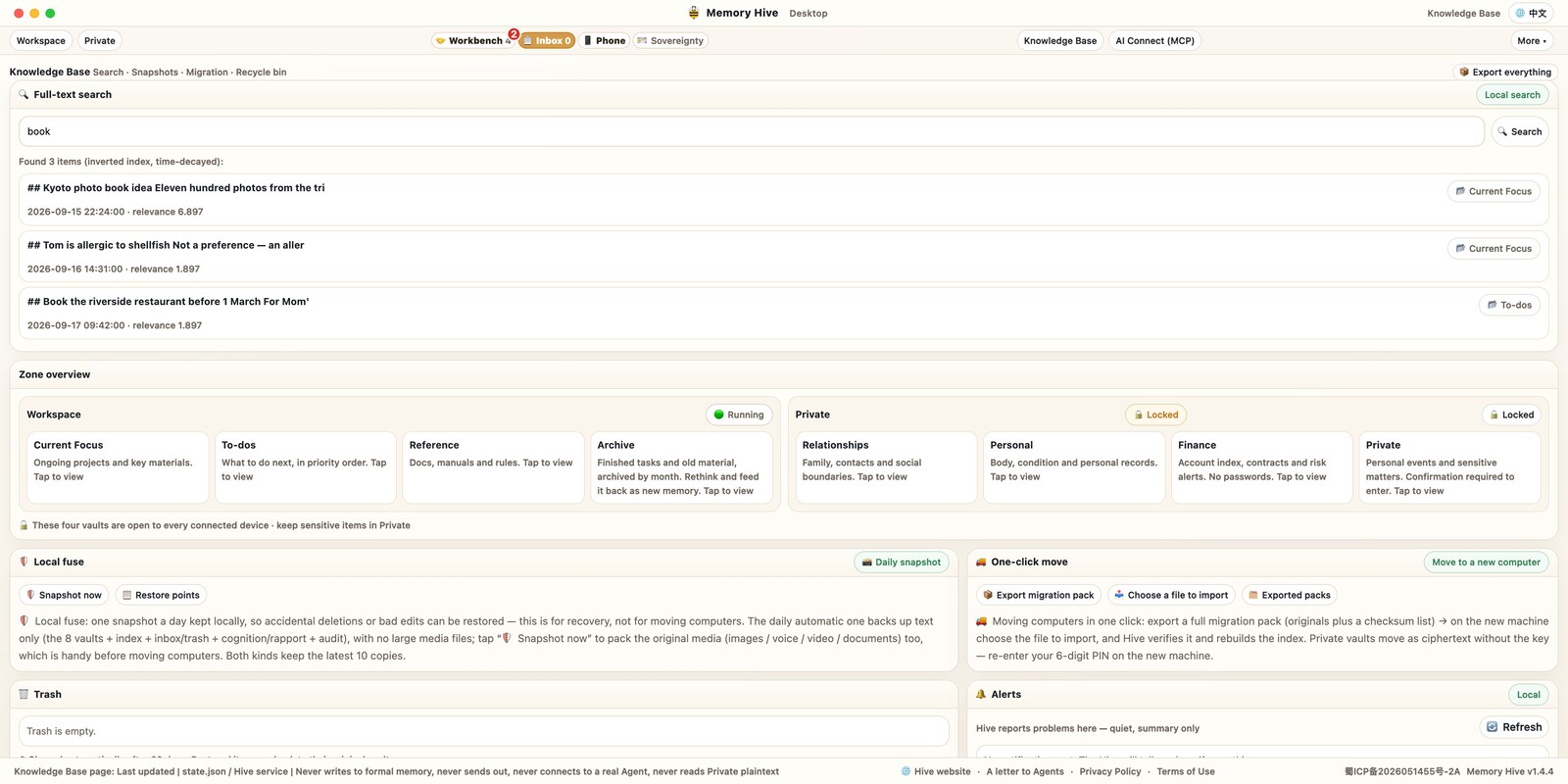
Claude today, DeepSeek tomorrow.
Your memory won't die with the switch.
Fengchao lives on your machine. Claude, Cursor, Codex, Gemini — any MCP client reads and writes your public memory, plug-and-play. Full client list →
Claude Desktop verified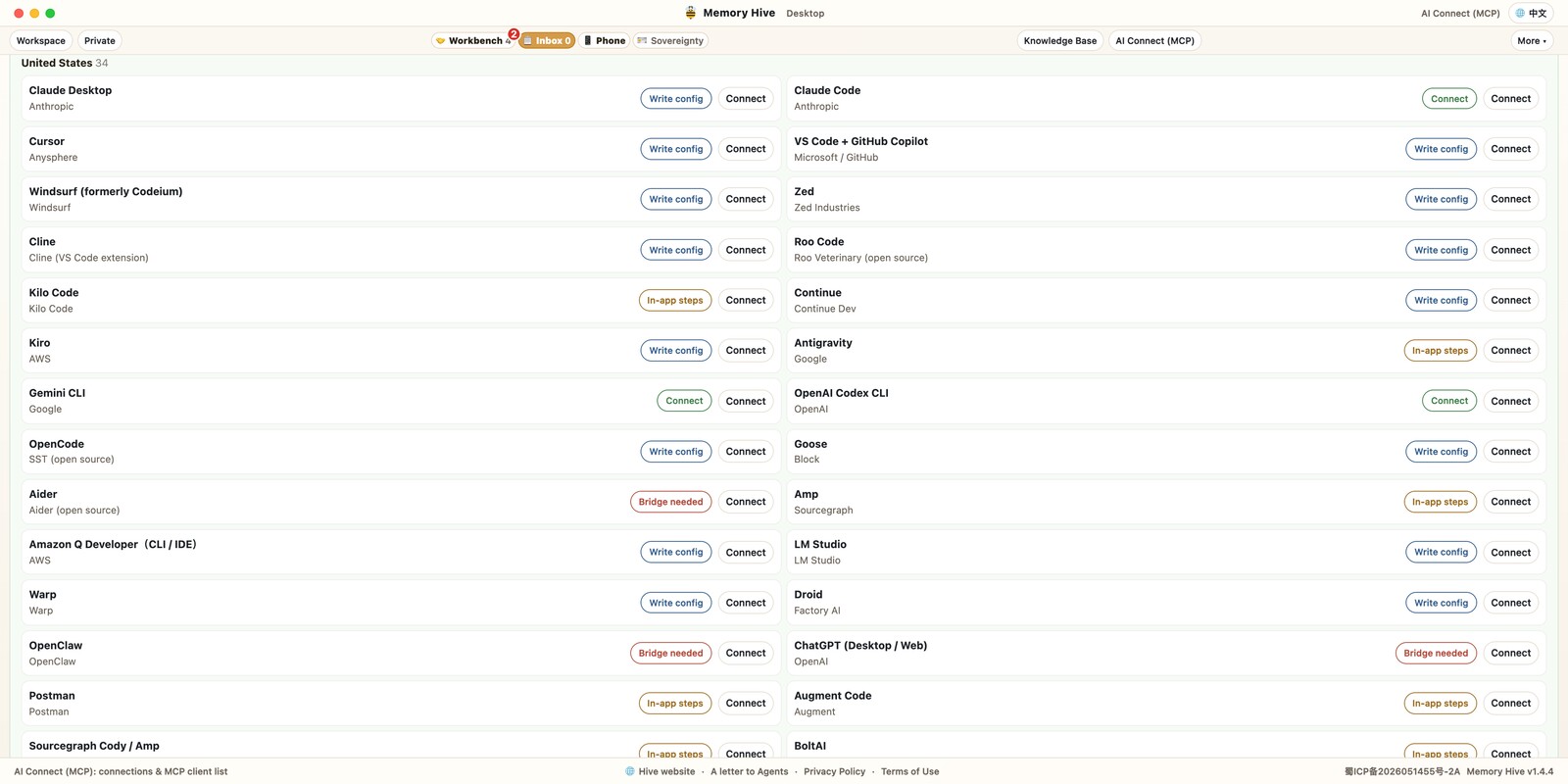
Passwords, keys, cards —
encrypted locally once you set a password, the keys are yours.
Passwords, keys, credentials, private notes go straight into an encrypted vault. Local storage + encryption — keys never leave your machine.
Relationships / personal / finance / private — independently encrypted